
Roof Ventilation vs. Insulation: What Actually Stops Ice Dams in Virginia
Every few winters, the Shenandoah Valley gets the right mix of snow, freezing nights, and brief thaws to produce ice dams — those thick ridges of ice that build up along the eaves and force meltwater back up under the shingles. Homeowners often assume more insulation alone solves the problem, but the real fix usually involves both insulation and ventilation working together. Get the balance wrong, and you can spend money without actually stopping the ice dams.
How Ice Dams Actually Form
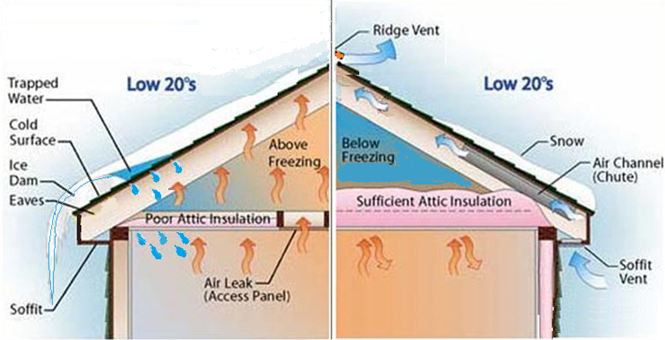
Ice dams aren’t caused by cold weather alone — they’re caused by uneven roof surface temperature. Heat escaping from the living space below warms the upper roof deck, melting snow on the warm upper section while the unheated eaves stay frozen. That meltwater runs down and refreezes right at the cold eave edge, building a dam that traps more water behind it, which then works its way under the shingles and into the attic or ceiling below.
The core principle: a properly performing attic should be cold enough that the entire roof surface stays close to outdoor temperature, so snow melts evenly (or not at all) instead of melting at the top and refreezing at the eaves.
Insulation’s Job: Stop Heat Loss
Insulation slows the transfer of heat from your living space into the attic. In Virginia’s climate zone, the Department of Energy generally recommends attic insulation levels in the R-49 to R-60 range for most homes, though older Shenandoah Valley homes are frequently found with far less, especially around recessed lighting, attic hatches, and top plates where insulation tends to get thin or compressed.
Common insulation gaps we find during attic inspections include:
- Compressed or missing insulation near the attic access hatch
- Bypasses around bathroom exhaust fans and recessed lights leaking warm air directly into the attic
- Insulation that has settled over decades, losing much of its original R-value
- Gaps where insulation doesn’t fully cover the top plate along exterior walls
Ventilation’s Job: Remove the Heat That Gets Through
No insulation job is perfect, so ventilation acts as a backup system — it continuously flushes any warm air that does escape into the attic before it can heat the roof deck. A balanced system pulls cool air in low through soffit vents and exhausts warm air high through ridge or roof vents, creating constant airflow across the underside of the roof deck.
Signs Your Attic Has a Ventilation Problem
- Visible frost or moisture on the underside of the roof deck in winter
- Ice dams that form even in homes with newer insulation
- Soffit vents painted over, blocked by insulation, or covered by bird/insect nests
- No visible ridge vent or insufficient exhaust vent area relative to attic size
Insulation vs. Ventilation: Which Fixes Ice Dams?
| Factor | Insulation | Ventilation |
|---|---|---|
| Primary role | Reduces heat escaping into attic | Removes heat that does escape |
| Fixes ice dams alone? | Partially – reduces but doesn’t eliminate risk | Partially – needs adequate insulation to work well |
| Common installation issue | Compression, settling, gaps at penetrations | Blocked soffits, insufficient exhaust area |
| Best approach | Both systems balanced together | |
Why You Need Both, Not Just One
Adding insulation without addressing ventilation can actually trap moisture in the attic, leading to mold and wood rot on the roof deck. Adding ventilation without addressing insulation gaps means you’re trying to flush out heat that shouldn’t be entering the attic in the first place. The two systems are designed to work together, and an attic energy audit is the most reliable way to find out which one (or both) needs attention in your specific home.
For baseline guidance on recommended insulation levels by climate zone, ENERGY STAR provides a helpful reference at the ENERGY STAR home insulation program, which Virginia homeowners can use to compare their current attic performance against recommended targets.
What a Proper Fix Looks Like
- Attic inspection — checking current insulation depth, ventilation type, and any air leaks from living space below
- Air sealing — closing gaps around fixtures, hatches, and top plates before adding more insulation
- Insulation top-up — bringing attic R-value up to recommended levels for our climate zone
- Ventilation balance check — confirming soffit intake and ridge/roof exhaust are proportional and unobstructed
FAQ
Will more insulation alone stop ice dams?
Not always. Insulation reduces heat loss, but without proper ventilation to remove the remaining heat, ice dams can still form, especially on roof sections with uneven insulation coverage.
How do I know if my attic ventilation is balanced?
A roofing professional can measure your soffit intake and ridge or roof vent exhaust area and compare it to your attic square footage to check the intake-to-exhaust ratio.
Are ice dams covered by homeowners insurance in Virginia?
Often, sudden interior water damage caused by ice dams is covered, but coverage varies by policy and insurer. Check your specific policy language or ask your agent directly.